

Youth in Governance and the Wisconsin Community Youth Corps
High school student Ignacio Tellez does not consider himself a future leader; he’s a leader now. “The verbiage that we use to describe youth as future leaders of tomorrow, that’s holding us back, like we’re gonna be there one day. But in reality, we’re leaders of today,” said Tellez. As part of Racine County’s Youth in Governance program, Tellez is learning how county government functions and about issues facing his community. He attends the Human and Health Development Committee each month, where he shares his perspective
Racine is one of eight Wisconsin counties that sponsor a Youth in Governance program facilitated by UW-Madison Extension. In those counties, youth are appointed to serve as voting members (non-binding) on the county board or its committees to share their views and suggestions on current issues. County supervisors and staff serve as mentors to youth participants, providing encouragement and answering questions they might have. Extension educators provide orientation, administrative support, and ongoing learning and leadership opportunities for participants.

Taking leadership to the next level
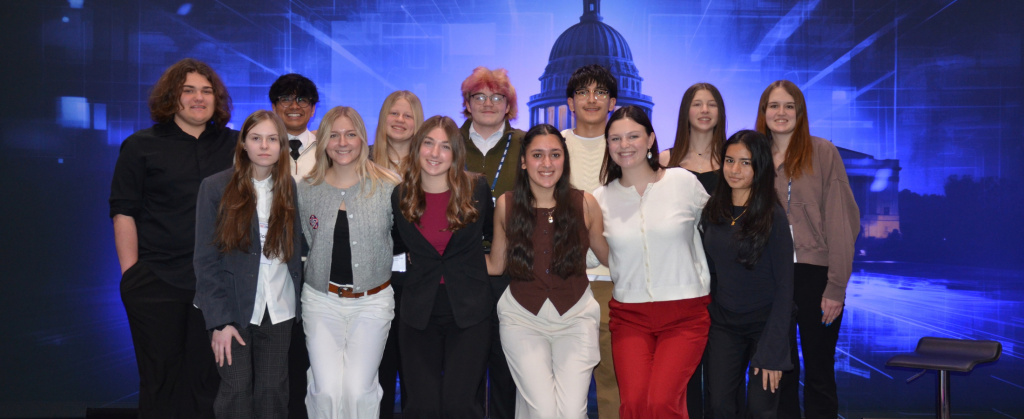
Tellez wanted to take his experience a step further, so he joined the Wisconsin Community Youth Corps, a new internship program. Funded by a two-year UW-Madison Reilly-Baldwin Wisconsin Idea Grant, Tellez and 11 other students are part of a pilot program focused on teaching them how to conduct community-based research and produce videos that share their perspectives.
Matt Calvert, Extension specialist and professor in the School of Human Ecology, and Neil Klemme, Iron County 4-H youth development educator, worked with a team of UW-Madison educators to apply for the grant. “Through Youth in Governance, we see that students who are engaged in government want to do more, but they’re not sure how,” said Calvert. “This is a great opportunity to help them gain those skills and provide a supportive space for them to practice.”
The project teaches the youth interns about public policy and community development, equipping them with the skills to tackle challenges they identify in their communities. The students presented research findings and video projects at the WCA Legislative Conference in February and to local county leaders in May. (To view the final research posters and watch video projects, visit go.wisc.edu/Youth-Corps.)
It’s not just about learning new skills. Through Youth Corps, Aleena Sanghvan, an intern in Dane County’s Youth in Governance program, has connected with other youth leaders across the state. Brainstorming and collaborating have helped her find like-minded peers. “One of the best things is getting to know other people who also want to make a difference in society. Because there’s this feeling you get when you’re working with other people, and they have the same goal as you, and they want to see your community thrive and flourish.” That feeling, says Sanghvan, motivates her to be active in her community.
Appreciating the role of local government
Triya Kalidindi, a Youth Corps intern in Racine County, used to pay more attention to state and national news, but now she understands how local policy directly impacts her life. “When I joined Youth in Governance, I think it really put a face, a name and a relationship to all the laws, ordinances, and all of that getting put in place in my town. I think it also made everything the county board does a little bigger in my eyes — being a part of the process, discussing with everyone, just as they’re about to make a decision. Through that, I’ve found how large and how big of a deal even the smallest ordinances or laws can be, and how they can affect my life.”
Participation in Youth in Governance increases participants’ willingness to take an active role in local government. That has long-term benefits for counties thinking about who will fill government roles in the future. “The experience in this program has strengthened my love for the state, and being involved has been fulfilling. I could definitely see myself working at the Capitol, or just in my county, coming back and paying it forward as well,” said Tellez.
Leading today and tomorrow
Sanghvan says she is empowered by the experience, noting that if something in her community doesn’t work, she realizes that she can do something about it. When Youth in Governance members see themselves as part of their community’s future, it increases the likelihood that, as adults, they will stay in the area or return to put down roots.
While Youth in Governance and the Youth Corps are most often associated with county government, Klemme has found more opportunities to get youth involved. “In Iron County, youth serve on nonprofit boards, the county board, and have advised placemaking and economic development teams. By including youth in those spaces and in important discussions, communities benefit,” he said.
Year two of the Youth Corps pilot will bring in students from other counties with Youth in Governance programs, add internship opportunities, and create learning materials that can be replicated when the pilot ends. In addition, Youth in Governance programs continue to be initiated in new counties, including Calumet County last year, where Extension has capacity in Positive Youth Development staffing.
In their own words…
As part of their internship, Youth Corps interns conducted local research and completed video projects, sharing the findings with their county board.
To see their research and video projects, visit go.wisc.edu/Youth-Corps.
This story was previously printed in the Wisconsin Counties Association Magazine.